

Flaming Hot Slot Review: One RTP, Four Meters
In short — our verdict: 6.1/10 — Flaming Hot is an Amusnet fruit slot that publishes a single 95.53% return for everyone, then gates its four Jackpot Cards meters behind a 5.00 qualifying bet you can't actually select, because the stake list jumps straight from 4.00 to 5.20.
Amusnet publishes one return figure for Flaming Hot, 95.53%, and prints it in two places that agree with each other. The four jackpot meters above the reels, though, only come alive from a 5.00 stake the bet list skips.
6.1/ 10
- Payout transparency8.5
- Rules documentation8.0
- Jackpot disclosure3.0
- Marketing accuracy4.5
- Provider traceability6.5
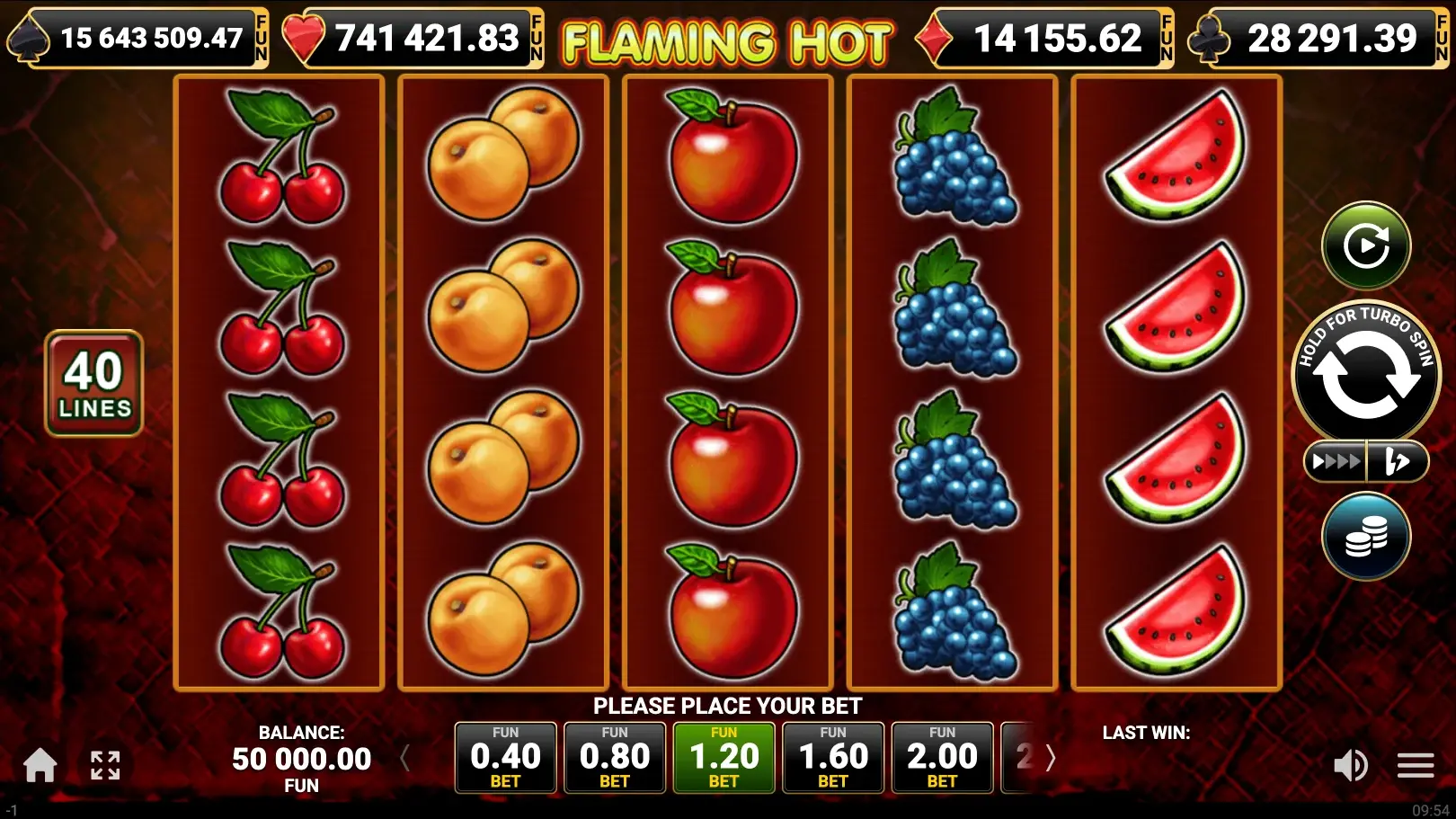
Table of contents
- Flaming Hot Strengths and Weaknesses
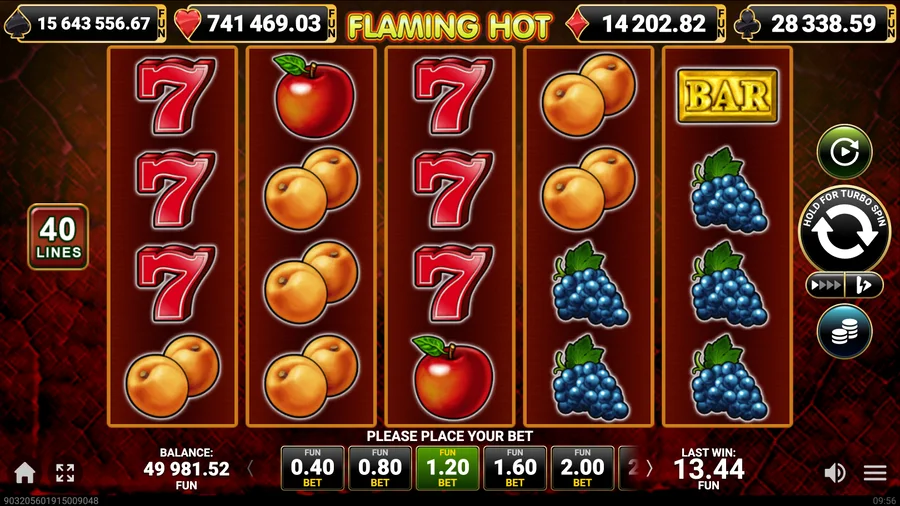
- Our 100 Flaming Hot Spins at 1.20
- How the Flaming Hot Grid Pays
- The 1000x Headline Is per Line
- Jackpot Cards: Four Levels, One Fee
- One Slot RTP, Two Kinds of Player
- Turbo Spin and Infinite Autoplay
- Bonus Spins Outside the Slot Rules
- Three Registers, Three Answers
- Mistakes Around the Qualifying Bet
- Opening the Flaming Hot Demo Yourself
- Our Flaming Hot Verdict and Rating
- Key Terms Used on This Page
- What Else Do Readers Ask
Flaming Hot Strengths and Weaknesses
Pros: What Works Well
- Pro: The return is published and the two places printing it agree: 95.53% on the client's rules screen and 95.53% on the studio's game page.
- Pro: Volatility is published as 2 out of 5, which plenty of makers leave blank, even though the scale itself goes unexplained.
- Pro: The rules document covers the mechanics we checked, giving Wild reels, the symbol table, Gamble limits, Autoplay and the payment rules their own sections.
- Pro: The per-line max-win wording on the studio's page is correct, and the paytable backs it up to the exact 30.00.
- Pro: Amusnet Interactive Ltd. is findable in a public register, at an address matching the footer of its own site.
Cons: What Holds It Back
- Con: One blended 95.53% covers a 0.40 player who sits below Jackpot Cards and a 5.20 player who qualifies for it.
- Con: The jackpot contribution rate, the seed and the level caps are all unpublished, so the base-game return stays out of reach of arithmetic.
- Con: The 5.00 stake button is missing, so the cheapest qualifying spin costs 5.20, which is 4.3 times the 1.20 default.
- Con: The published maximum of 1000x a line comes to 30.00 at a 1.20 stake, while the same paytable pays 600.00 for five Scatters, and the two figures are never reconciled.
- Con: The studio's game page promises free bonus spins that the rules document leaves undescribed.
- Con: Hit frequency is published nowhere, and the odds of the top prize appear on neither the game page nor the rules screen.
- Con: Turbo Spin, Quick spin and infinite autoplay all ship in the demo that everybody sees.
Our 100 Flaming Hot Spins at 1.20
| Measure | Result |
|---|---|
| Paid spins | 100 |
| Stake a spin | 1.20 |
| Total staked | 120.00 |
| Returned | 244.56 |
| Net | plus 124.56 |
| Return over the run | 203.8% |
| Best single round | 70.80 |
| Jackpot Cards triggers | 0 |
Read on ; the maker can change a screen without saying so.
How the Flaming Hot Grid Pays
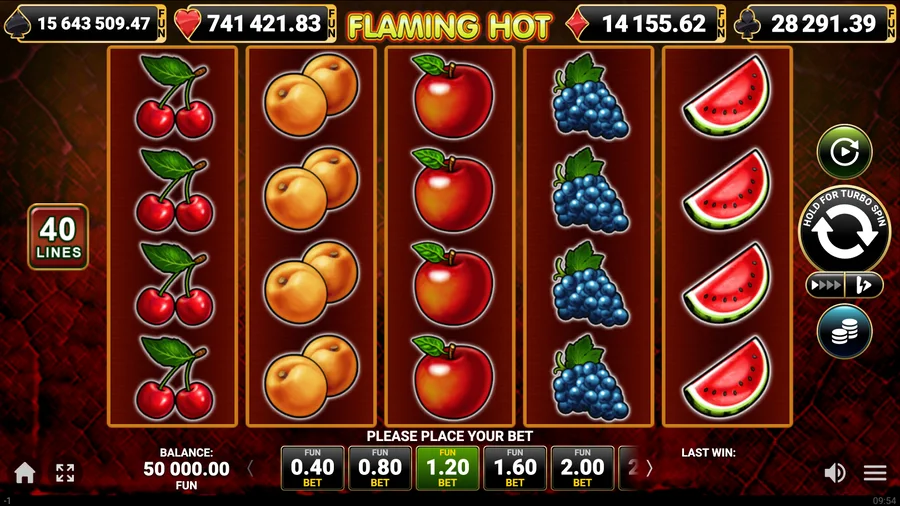
The grid pays left to right along forty fixed lines, and every line win is multiplied by the bet riding that one line rather than by your whole stake. Five reels, four rows, ten symbols, one Wild and one Scatter. The rules put the frame plainly: "Flaming Hot video slot is a 5-reel, 40-line fixed game."
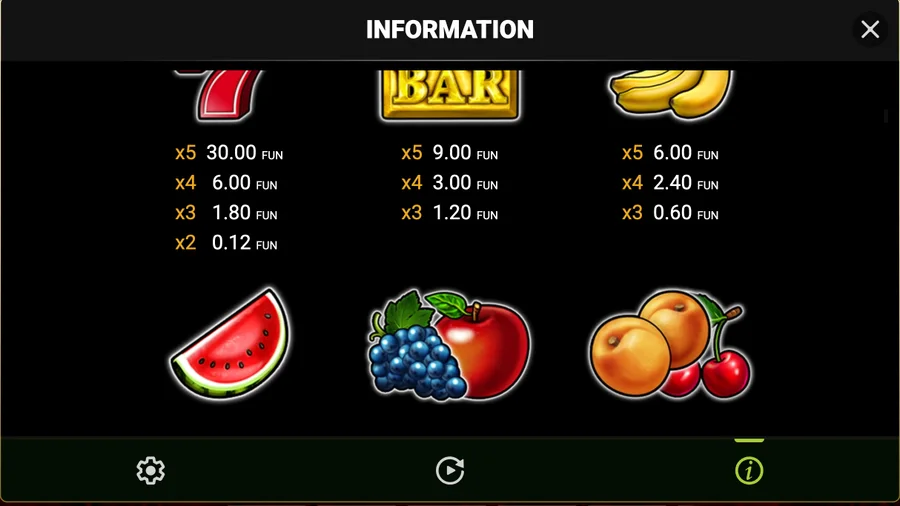
The Wild lands only on reels two, three and four, and it stands in for every symbol except the Scatter. Read its panel on the rules screen and you find something the catalogues skip. It prints where the Wild appears and what it replaces, and it prints no prize at all. The amounts of 600.00, 24.00 and 2.40 on that same screen sit in the right-hand column, which belongs to the Scatter, the dollar sign. We had that the wrong way round ourselves until we went back to the capture.
The seven is the only symbol paying from two of a kind, at 0.12.
Line wins and Scatter wins are costed differently, and the rules say so. "Line wins are multiplied by the bet value on the winning line. Scatter wins are multiplied by the total bet value." Hold on to that sentence, because the next section is built on it.
The 1000x Headline Is per Line
The headline maximum is a line figure rather than a spin figure, and the studio's own wording says so: "Max-win: 1000 x bet per line". Two of those words do all the work.
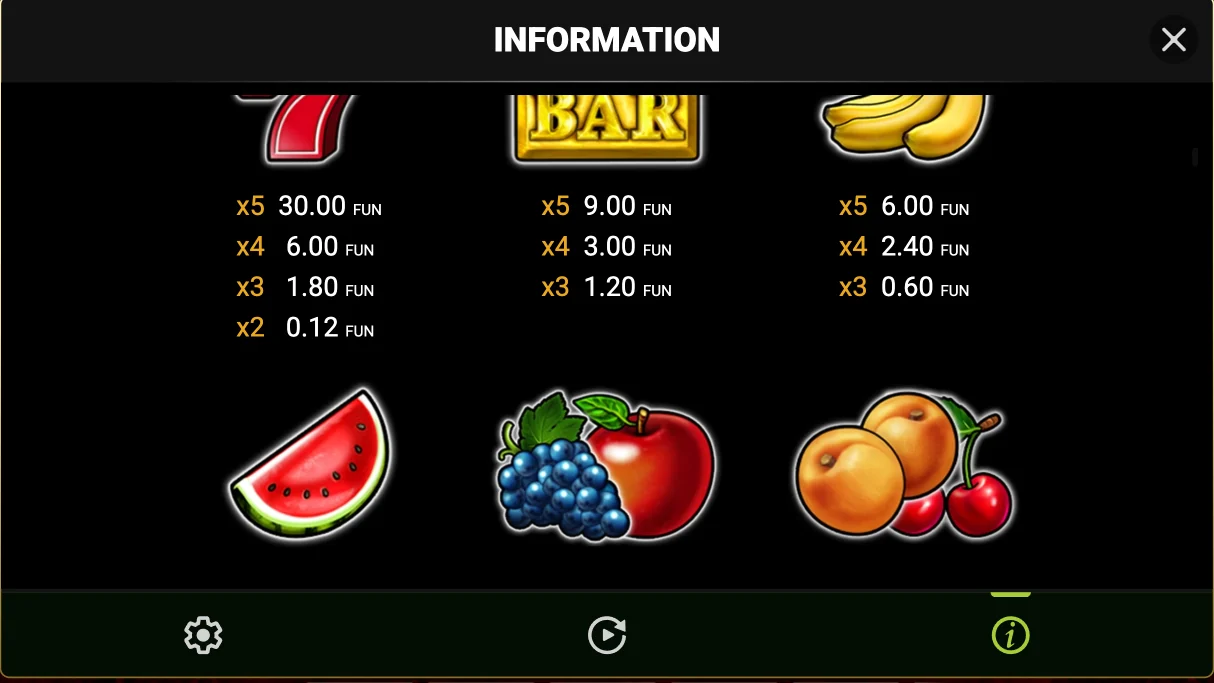
With forty fixed lines, a 1.20 spin puts 0.03 on each line. A 1000x cap on that line tops out at 30.00. In total-bet terms, that is 25x.
The paytable agrees. Five red sevens pay exactly 30.00 at a 1.20 stake, because the cap applies to the 0.03 riding one line. Two readings, taken off two different screens, land on one number.
| Reading | What it gives at a 1.20 stake |
|---|---|
| Studio key facts, 1000x per line | 30.00 |
| Paytable, five red sevens on one line | 30.00 |
| Paytable, five Scatters on the total bet | 600.00 |
| If the cap were per spin (the catalogue reading) | 1,200.00 |
Aggregator pages dispute the maker here, and they do it by omission. Several catalogue entries we read print a "maximum win of 1,000x the bet" with the words "per line" dropped. The studio's own page confirms the per-line wording and the paytable corroborates it, so the catalogues contradict both. Forty times the difference hangs on two missing words.
Then there is the figure that pulls the other way, and it comes off the maker's own paytable. The Scatter is multiplied by the total bet, so five of them return 600.00 on a 1.20 stake. That is 500x the stake. The published maximum, read exactly as the studio writes it, comes to 30.00 on the same stake. One screen carries a stated ceiling twenty times smaller than the largest prize on the screen beside it. How Amusnet arrives at its max-win figure we cannot see, and we are not calling it a mistake: both numbers are the maker's own, and they do not meet.
One caveat, and it matters, because 25x caps a single base-game line and not a round. Several of the forty lines can pay together, which is how our own best round returned 70.80 on a 1.20 stake, 59x it. The Scatter is paid on the total bet, up to that 500x. Jackpot Cards sits above the base game, and Gamble can double a win on top of that. Anyone quoting us as "this slot pays 25x maximum" has over-read the sentence.
Jackpot Cards: Four Levels, One Fee
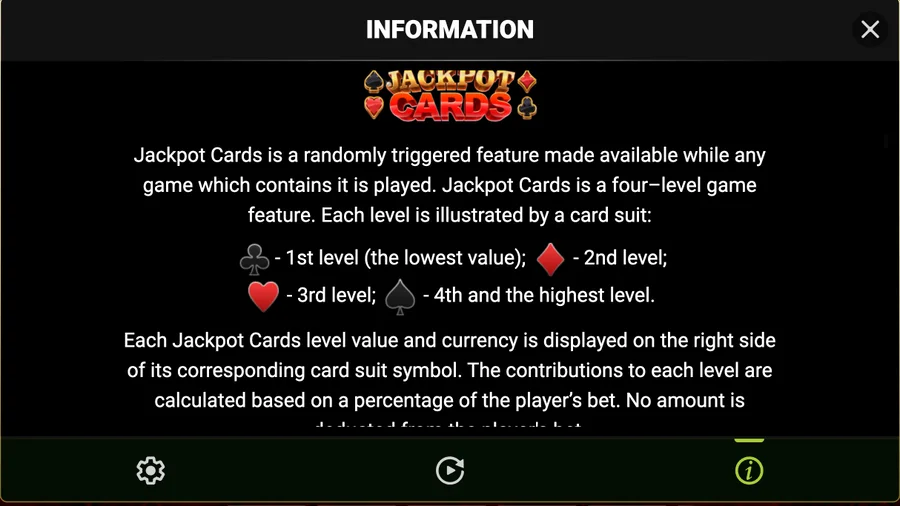
Jackpot Cards hands over one of four suit-ranked levels every time it fires, and it fires at random once a round has been settled. Four meters hang above the reels on every screen, one per suit. Clubs is level one and the smallest, then diamonds, then hearts, and spades pays most.
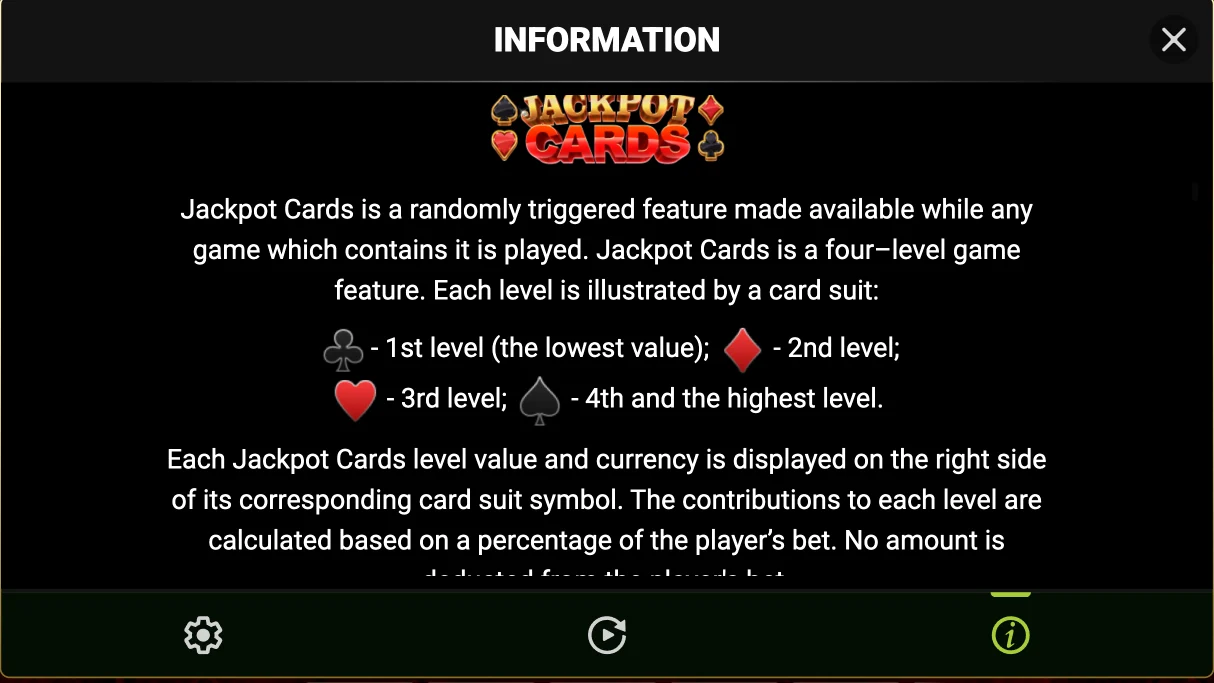
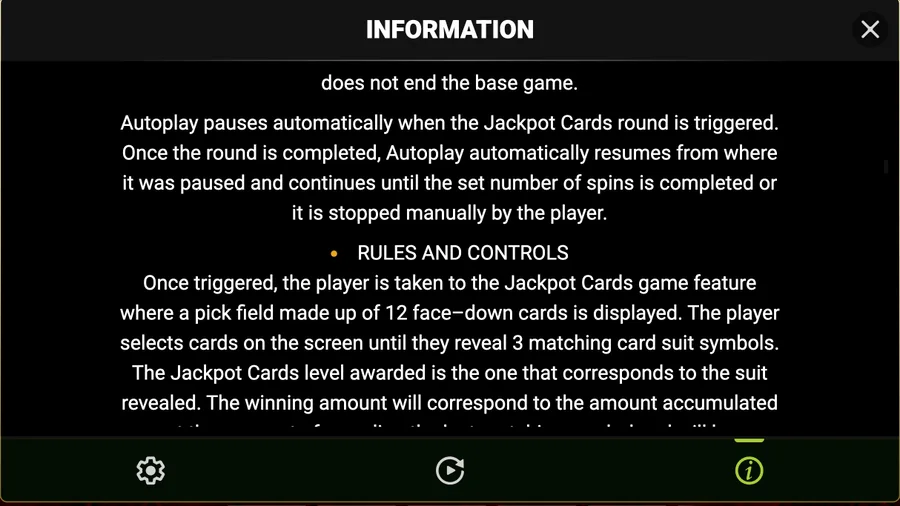
You get twelve cards face down and keep turning them until three suits match. The suit sets the level. The amount is whatever that meter held when you opened it, and autoplay pauses while the round runs. The base game stays open underneath. Everyone playing the feature when a level drops gets told about it.
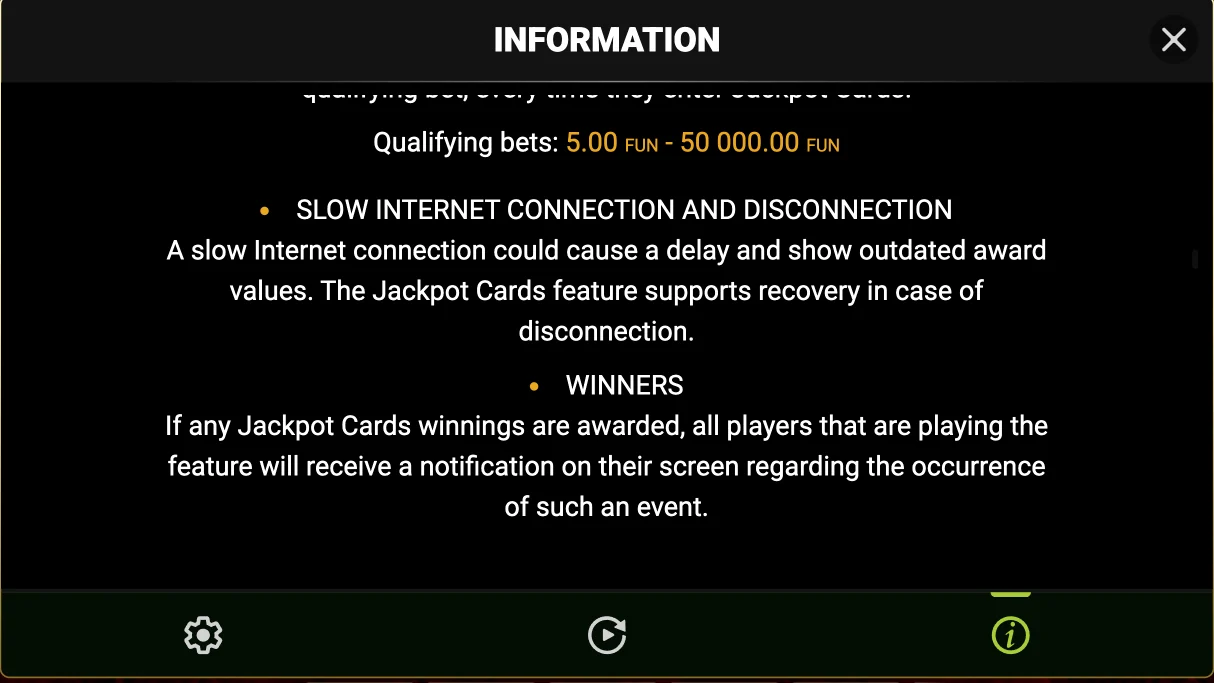
Then comes the line that reframes the whole game. The rules state "Qualifying bets: 5.00 - 50,000.00". Below 5.00 the meters still hang there, lit and counting up, and they stay out of reach.
One Slot RTP, Two Kinds of Player
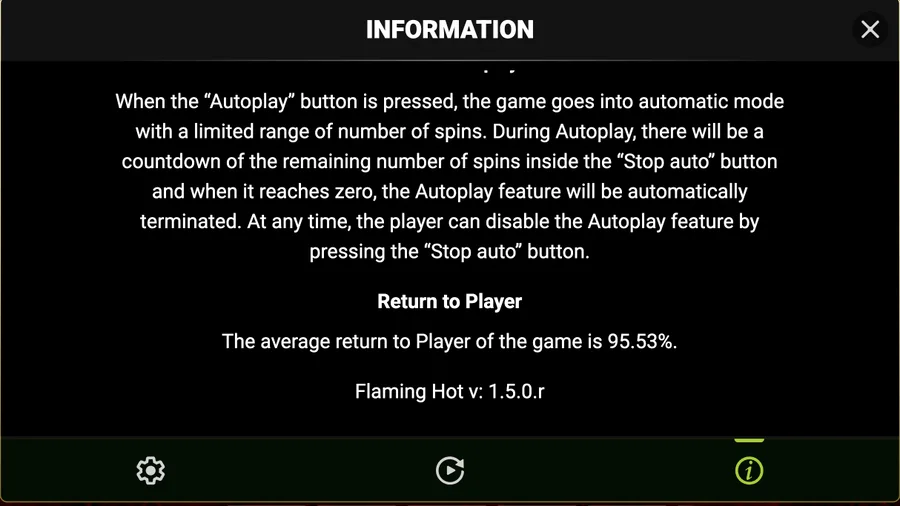
One figure, 95.53%, is quoted to both kinds of player: the one whose stake reaches the four meters and the one whose stake never can. It is printed twice and both prints agree. The rules screen says "The average return to Player of the game is 95.53%". The key-facts list on the studio's game page carries the same figure. Agreement across two surfaces is worth more than it sounds, and on this one Amusnet is straight with you.
What's missing is the split.
Jackpot Cards is funded out of play, and the rules state that openly. "The contributions to each level are calculated based on a percentage of the player's bet. No amount is deducted from the player's bet." The percentage itself stays unprinted. The seed each level restarts from is absent too, and a cap on a level appears nowhere.
So the published 95.53% is one blended number. It covers a player at 0.40 whose spins stay below the meters. It covers a player at 5.20 who can reach them. Those two cannot be getting the same return, though the game prints one figure for both.
Working out the 0.40 player's real return needs the jackpot's share, and nobody publishes that. We can't calculate it, and neither can you. That is the finding on this page.
For scale, Britain's technical standards treat eligibility as a disclosure matter. RTS 9A reads: "If a player is not eligible for a game's progressive jackpot prize this should be made clear, along with their respective theoretical RTP." Amusnet holds no British licence at all. A British build of this game exists nowhere, so the standard is a yardstick borrowed from another market rather than a rule being broken here.
Turbo Spin and Infinite Autoplay
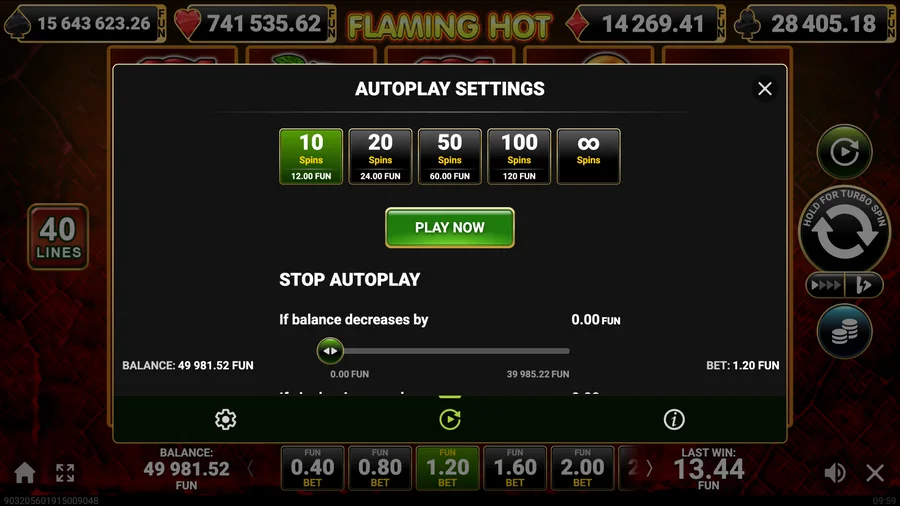
Turbo Spin, a separate Quick spin switch and an unlimited autoplay setting all ship in the free demo, and the start button announces the first of them. It is labelled "HOLD FOR TURBO SPIN". The rules explain it: "The player can hold the button to activate the Turbo Spin function, which speeds up the rotation of the reels." GAME SETTINGS carries the Quick spin toggle. Autoplay offers 10, 20, 50, 100 and infinite spins, with stops on loss and on a big win.
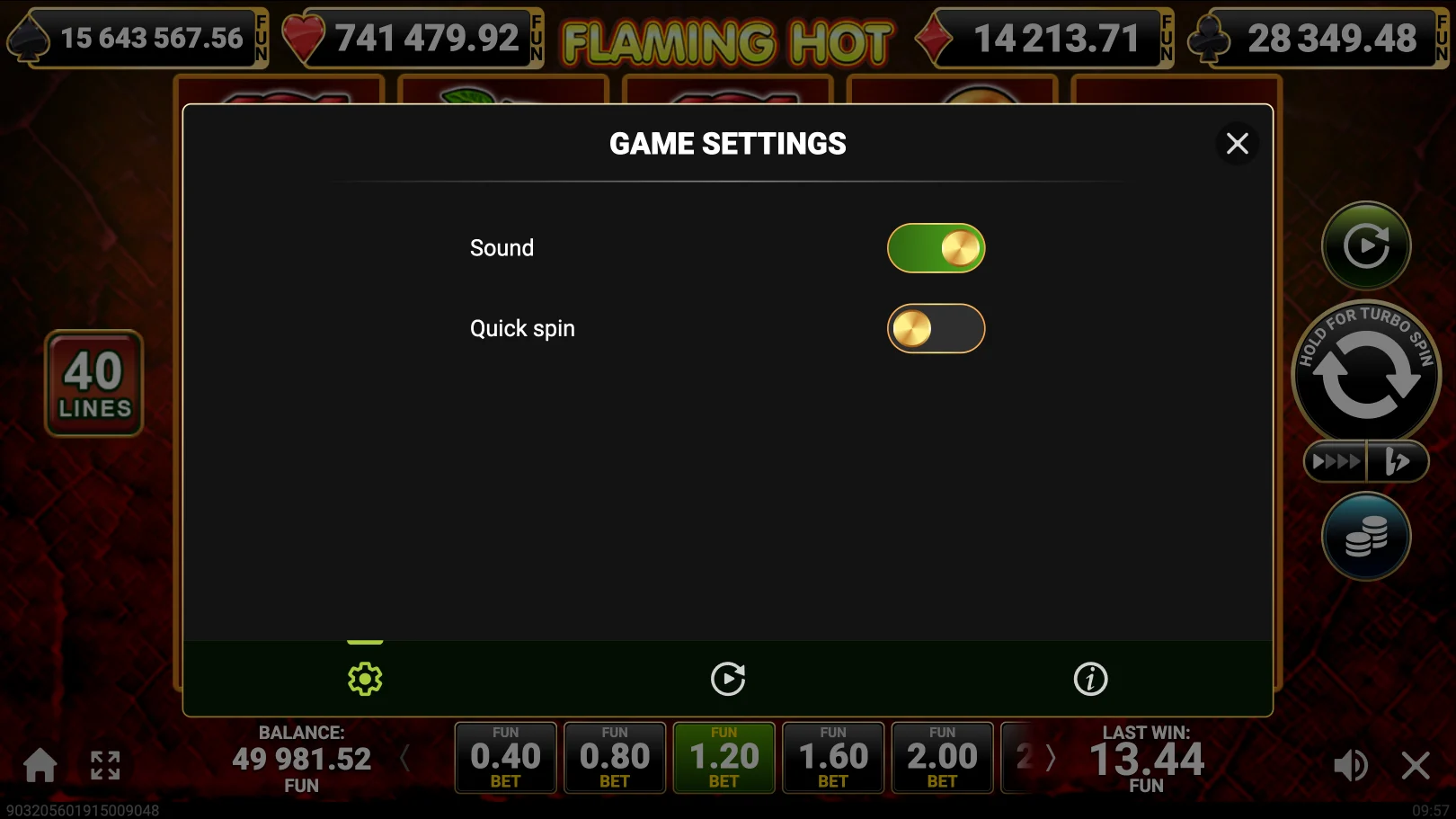
Three British rules speak to exactly these controls.
- RTS 14E: "Features such as turbo, quick spin and slam stop are not permitted."
- RTS 14D asks for a minimum of 2.5 seconds a cycle, and for the start button to be released and pressed again. This function works by holding it down.
- RTS 8A: "The gambling system must require a customer to commit to each game cycle individually."
Say that precisely, because the precise version is the interesting one. The demo we played is assembled to settings Britain would refuse. Britain licensed this maker nowhere either, so a British build was always off the table. What you are looking at is a game built for other markets and shown to everybody.
Bonus Spins Outside the Slot Rules
Bonus spins live on the studio's marketing page and in no section of the rules document. The game page promises "extra rewards thanks to the free bonus spins you can get throughout the gameplay." We read the rules end to end looking for them.
Here is what sits in there instead:
- Introduction, then Wild and Scatter, then the symbol table.
- Jackpot Cards, Gamble, the forty lines and the payment rules.
- The buttons, Game Interruptions, Autoplay, Return to Player.
Bonus spins appear nowhere in that list. The Scatter pays cash rather than spins, returning 2.40 for three at a 1.20 stake.
That is a gap between a marketing page and a rules document, and we would rather describe it that way than guess at a motive. If a spins round is what you are shopping for, the rules are the document that would have to describe it, and they stay quiet.
Three Registers, Three Answers
We pulled three registers on and got three different pictures of one studio.

| Register | What it returns |
|---|---|
| UKGC, 2,635 + 4,506 + 2,412 records | zero entries for Amusnet, EGT or Euro Games |
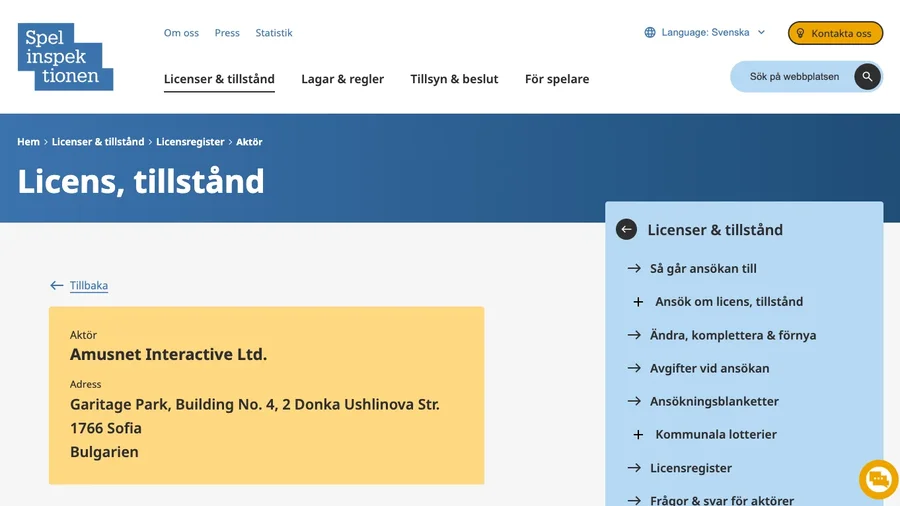
| Spelinspektionen, 2,188 holders | Amusnet Interactive Ltd., Sofia, Spelprogramvara, valid to |
| Gibraltar government PDF | Amusnet (Gibraltar) Limited, RGL No. 162, issued |
The three British files are business records, licence records and trading names, in that order, and the studio's name is in none of them.
The Swedish entry is the useful one. It gives the company as Amusnet Interactive Ltd., at Garitage Park, 2 Donka Ushlinova Str., 1766 Sofia, Bulgaria. Category Spelprogramvara, status Giltig. That address matches the footer of the studio's own site.
We checked the British download was answering us properly, by searching the same files for Evolution Malta Holding Limited, Playtech Plc and Pragmatic. All three came back. Amusnet is genuinely absent.
One more thing the Swedish register settles. EGT Digital Ltd. and EGT Digital Malta Limited are listed separately, and they are a different company. The game called Flaming Hot Clover Chance belongs to them. Catalogues merge those names; the register keeps them apart, so we do too.
Mistakes Around the Qualifying Bet
The first mistake is reading the meters as part of the deal at any stake. They are decoration below 5.00. The game opens at 1.20 and goes down to 0.40, and both sit under the qualifying floor.
The second one is subtler. The 5.00 button is missing. The forty stake levels step 4.00, then 5.20, then 6.00. So the cheapest qualifying spin costs 5.20, which is 4.3 times the default. A player who nudges the stake towards 5.00 and stops there has paid more a round and bought nothing.
We do not recommend chasing the four levels at 5.20 on a bankroll you sized for 1.20 spins. The jackpot's share of the return is unpublished, so you would pay 4.3x a spin for an upside you can't price.
If neither stake suits you, the honest third option is the demo, where nothing qualifies and nothing is at risk.
Opening the Flaming Hot Demo Yourself
The demo opens from the studio's own site and nowhere else, and that is a limit we can't engineer away. The launcher refuses a session without a one-time token. We tried three forms of the address and got 400 back each time. The token comes from the studio's own game page, and it lives for hours.
The route is short, though. Open the Flaming Hot page on the Amusnet site, clear the studio's own 18+ gate, and press Play Demo. The rules screen opens from the game's menu once the client loads. That is where the 95.53% line and the Qualifying bets line sit, in front of your own eyes.
| Line | Figure |
|---|---|
| Published return | 95.53% |
| Expected net over 100 spins at 1.20 | minus 5.37 |
| Our net | plus 124.56 |
| Gap | 129.93 |
Our Flaming Hot Verdict and Rating
Key Terms Used on This Page
- Jackpot Cards
- Amusnet's four-level progressive, clubs lowest and spades highest, playable only from a 5.00 qualifying bet upward.
- Qualifying bets
- The stake band that makes a spin eligible for the jackpot, printed in the rules as 5.00 to 50,000.00.
- Return to Player
- The share of stakes a game is built to pay back over time, stated here as one figure, 95.53%.
- Bet per line
- Your total stake divided across the forty fixed lines, so 1.20 becomes 0.03 a line and the 1000x cap applies to that.
- Scatter
- The dollar sign, paid from anywhere and multiplied by the total bet: 600.00 for five at a 1.20 stake, which is 500x that stake.
- Gamble
- Double or nothing on red or black for wins up to 42.00 at a 1.20 stake, with the number of attempts set per game rather than by the player.
- Wild
- The substitute symbol, landing only on reels two, three and four, standing in for every symbol except the Scatter and carrying no prize of its own.
Not sure yet? Try the free demo first and learn the round with play money before any deposit.
Try the free demo first →This site takes no deposits and runs no identity checks; both stay off it entirely.
Related Reading on This Game
More on this game, from the same section first:
 Guides
Free Demo Check
95.53% printed on the rules screen
 Reference
Return Figure Explained
95.53% published, 4.47% house edge
 Guides
Jackpot Cards Explained
Qualifying bets start at 5.00
 Reference
Max win in numbers
Max win 1000x per line, not total
 Reference
Paytable, tier by tier
Five red sevens pay 30.00 at 1.20
 Reference
Extreme and Bell Link
95.53% belongs to the base game
 Reference
Base vs Extreme
95.53% proven on one of two
 Guides
Lobby checklist
No Amusnet entry in 2,635 businesses
What Else Do Readers Ask?
These are the questions we kept hitting while we played and while we read the rules screen. The answers come from the client's own rules document, the Amusnet game page and our 100-spin run on .
Do I need to register to try Flaming Hot for free?
No, the studio's demo opens straight from its own game page after an 18+ confirmation, and it asks for no account and no deposit.
Where in the client can I see the return figure myself?
Open the rules screen from the game menu and scroll to Return to Player, where one sentence prints the 95.53% figure in plain text.
How many Gamble attempts does a single win get?
The rules put the number between 1 and 5 depending on the game's own settings, so it is set per game rather than by the player.
Can the forty lines be reduced to stretch a balance?
No, all forty lines are fixed, so the only lever on cost a round is the stake, which steps from 0.40 up to 100.00.
Does the Wild pay anything on its own?
No, the rules print its reels and its substitution rule and no prize, so the 600.00 beside it on screen belongs to the Scatter.
What does the 2 out of 5 volatility rating mean here?
Amusnet prints that rating on its game page but leaves the scale unexplained, so read it as the maker's own ranking rather than a measured value.
How do we test a slot like this one?
We play paid spins in the demo, read the rules screen end to end, cross-check the paytable maths and look the maker up in public registers.